

So, you’ve driven your sleek, silent, zero-emission chariot for a decade, saving the planet one smug glance at gas stations at a time. But now, your once-mighty battery is wheezing, barely holding a charge. The dealership hits you with the bad news—you need a new battery.
No big deal, right? Just swap it out and keep rolling.
But here’s the question no one’s asking:
What happens to the old one?
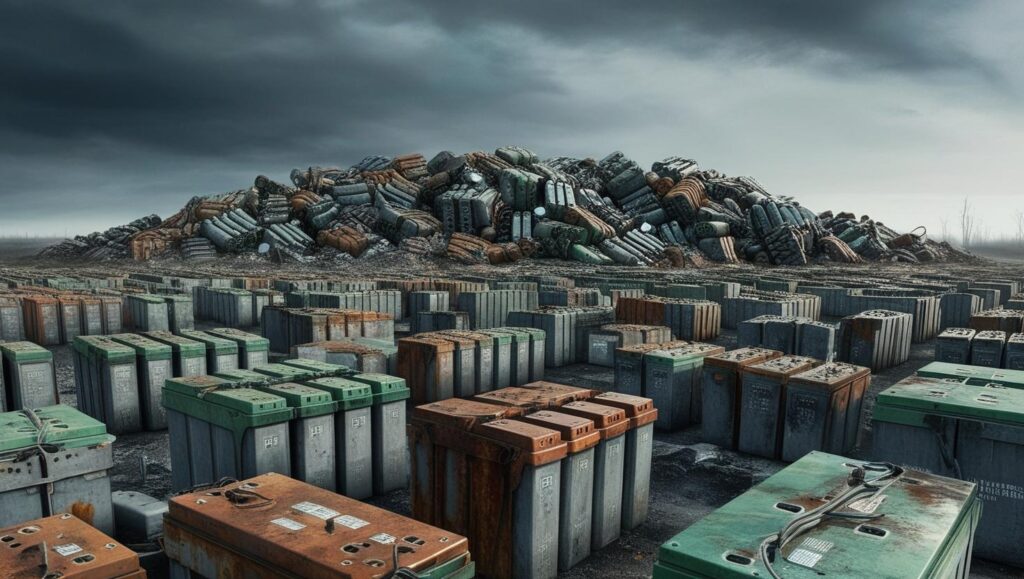
Spoiler alert: Right now, we don’t really have a good answer. And unless we figure it out soon, we’re looking at gigantic graveyards of dead EV batteries piling up like an environmental horror movie.
Let’s break it down.
The Elephant in the Junkyard: EV Batteries Don’t Die Pretty
Gas cars are easy to dispose of—strip them for parts, crush them into cubes, or turn them into Mad Max props. EV batteries?
Not so simple.
- They’re huge (some weigh over 1,000 lbs).
- They’re full of toxic and flammable materials (fun!).
- They’re not designed for easy recycling (why plan ahead, right?).
Right now, most EV batteries end up in landfills or sitting in warehouses, waiting for us to figure out what to do with them. And unlike that old Nokia you forgot in a drawer, these batteries don’t just sit quietly—they can leak chemicals, catch fire, or even explode.
So much for that clean, green revolution.
Why Aren’t We Recycling These Things Already?
Good question. The short answer? Because it’s a nightmare.
🔧 They’re hard to take apart – EV batteries aren’t made for quick disassembly. Trying to extract useful materials is like playing Operation, but the board game explodes if you mess up.
💰 It’s not profitable (yet) – Mining fresh lithium, cobalt, and nickel is still cheaper than recycling old batteries. Until that changes, companies aren’t in a rush to fix the problem.
🔥 Fire hazard galore – Mishandling lithium-ion batteries can lead to thermal runaway (a fancy term for “spontaneous combustion”). Not exactly the kind of recycling challenge we asked for.
🔄 There’s no universal system – Different car companies use different battery designs, making large-scale recycling a logistical headache. It’s like if every phone brand had a unique charger (oh wait…).
Right now, less than 5% of lithium-ion batteries get recycled. That means 95% of them are just sitting around, waiting to become a problem.
The Future Battery Apocalypse (If We Don’t Fix This)
Let’s do some quick math (don’t worry, no pop quiz).
- Over 10 million EVs were sold in 2023.
- EV batteries typically last 8-15 years before they need replacing.
- By 2035, millions of batteries will be retiring every year.
If we don’t figure out large-scale recycling, the planet will be drowning in toxic, dead batteries. Landfills will look like post-apocalyptic wastelands of lithium and cobalt. And all that “sustainable” energy? Yeah, not so sustainable anymore.
Imagine future archaeologists digging up mountains of abandoned EV batteries, scratching their heads, and wondering if we ever learned how to finish what we started.
How Do We Actually Fix This?
Alright, it’s not all doom and gloom. Some smart people are working on solutions—if we actually get our act together.
1. Make Battery Recycling Mandatory
Right now, EV makers aren’t required to handle battery disposal. That needs to change. Governments need to force manufacturers to build recycling into their business models—like a return-and-reuse system.
Currently, many EV manufacturers are not obligated to manage battery disposal, leading to environmental concerns. To combat this, policies enforcing producer responsibility for battery recycling are essential. The European Union (EU) has taken a proactive stance with its Battery Regulation, mandating that, by 2030, EV batteries must contain minimum recycled content: 6% for lithium and nickel, and 16% for cobalt. This regulation aims to reduce reliance on raw material extraction and promote a circular economy.
2. Build Batteries That Are Easier to Recycle
Right now, EV batteries are a nightmare to take apart. We need designs that let us easily extract valuable materials instead of turning the recycling process into a high-risk escape room challenge.
The complexity of current EV battery designs poses significant challenges for recycling. Simplifying battery architecture can facilitate material recovery and reduce environmental impact. The Union of Concerned Scientists emphasizes that considering end-of-life during the design phase can make disassembly safer and more efficient, potentially incorporating features like standardized pack designs and the use of binders instead of adhesives.
3. Invest in Better Recycling Tech
New methods like hydrometallurgical processing (fancy word for breaking down batteries without fire hazards) are making recycling safer and more efficient. But we need more funding to scale this up.
Innovations in recycling processes are crucial for improving the efficiency and safety of material recovery from used batteries. Hydrometallurgical processing, which involves leaching metals from shredded battery materials using aqueous solutions, has emerged as a promising method. Companies like Redwood Materials, founded by Tesla co-founder JB Straubel, are pioneering such technologies, achieving up to 95% recovery of critical minerals and significantly reducing carbon emissions compared to traditional methods.
4. Use Old Batteries for Energy Storage
Just because a battery is too weak for a car doesn’t mean it’s completely useless. Some companies are repurposing old EV batteries for grid storage, helping store renewable energy. Smart move.
Batteries that no longer meet the performance standards for EVs can still serve in less demanding applications, such as stationary energy storage. Repurposing these batteries can support renewable energy integration and grid stability. The Union of Concerned Scientists advocates for the reuse and repurposing of batteries with remaining capacity before recycling, highlighting the environmental benefits of such practices.
5. Stop Treating Lithium as a Disposable Resource
We mine lithium like there’s no tomorrow, but guess what? It’s not unlimited. Instead of constantly digging up more, we should be recycling what we’ve already pulled out of the ground.
The current rate of lithium extraction is unsustainable, given its finite availability. Recycling existing lithium from used batteries can alleviate the pressure on natural reserves. The EU’s regulatory framework underscores this by setting targets for recycled content in new batteries, aiming to create a closed-loop system that minimizes the need for new mining activities.
Final Verdict: The EV Revolution Isn’t Complete Yet
Look, EVs are still better than gas-guzzlers in the long run. But if we don’t solve the battery disposal problem, we’re just trading one environmental disaster for another.
Right now, we’re acting like someone who cleaned their living room by shoving everything into the closet and pretending it’s gone. If we don’t figure out how to recycle and reuse these batteries properly, we’ll have a future full of battery graveyards—polluting the very planet EVs were supposed to save.
So before we pat ourselves on the back for “going electric,” let’s ask: Are we really solving the problem, or just delaying it? Because if we don’t start fixing this now, future generations will be stuck with our mess—and they won’t be able to recycle our excuses.
The issue of abandoned electric vehicles (EVs) has become a significant environmental concern, with several notable instances worldwide:
Rapid expansion in China’s EV market, bolstered by government subsidies, led to an oversupply of electric cars. Many early models, especially those used by ride-hailing services, were abandoned due to company bankruptcies and technological obsolescence. These vehicles have accumulated in large lots, often referred to as “EV graveyards.” While some reports highlight these sites as evidence of waste, others argue that the images are outdated and not representative of the current state of China’s EV industry https://www.bloomberg.com/features/2023-china-ev-graveyards
In Laon, France, a facility managed by Groupe Renault serves as a repository for thousands of decommissioned electric car batteries. This site underscores the growing challenge of safely disposing of and recycling EV batteries as the adoption of electric vehicles increases. The facility highlights the need for sustainable solutions to manage battery waste effectively. https://electriccarwiki.com/electric-car-battery-graveyard-france/
In the U.S., companies like Redwood Materials, founded by Tesla co-founder JB Straubel, are addressing the issue by developing advanced recycling technologies. Redwood Materials focuses on extracting valuable materials from used lithium-ion batteries, aiming to reduce environmental impact and support a circular economy in the EV sector.https://time.com/7172584/jb-straubel-2/
DISCLAIMER: READ THIS BEFORE YOU GET ALL CHARGED UP
Before you start foaming at the mouth and composing a 10-paragraph rebuttal about how EVs are the future, the solution, and possibly your one true love, let’s pump the regenerative brakes for a second.
This isn’t an anti-EV rant. This isn’t pro-oil propaganda. And no, Big Coal didn’t pay me in sacks of carbon to write this (but if they want to, my DMs are open).
What this is, however, is a cold, hard reality check. Because while we all love the idea of a clean, green, electric-powered utopia, there’s one teensy little problem: dead batteries don’t just disappear into thin air. And unless we figure out how to recycle them properly, we’re basically just swapping gas stations for battery graveyards—which, surprise, isn’t much better.
So, if this article makes you uncomfortable, annoyed, or questioning your entire existence, congratulations! That’s called critical thinking. Side effects may include:
✔️ Sudden skepticism of corporate greenwashing
✔️ An uncontrollable urge to Google “EV battery recycling crisis”
✔️ Existential dread about the sustainability of modern technology
If symptoms persist, consult a scientist, an engineer, or literally anyone who isn’t just repeating “EVs are the answer” like a broken record.
Now, let’s dive into the mess we’re making—and the mess we still don’t know how to clean up.
