
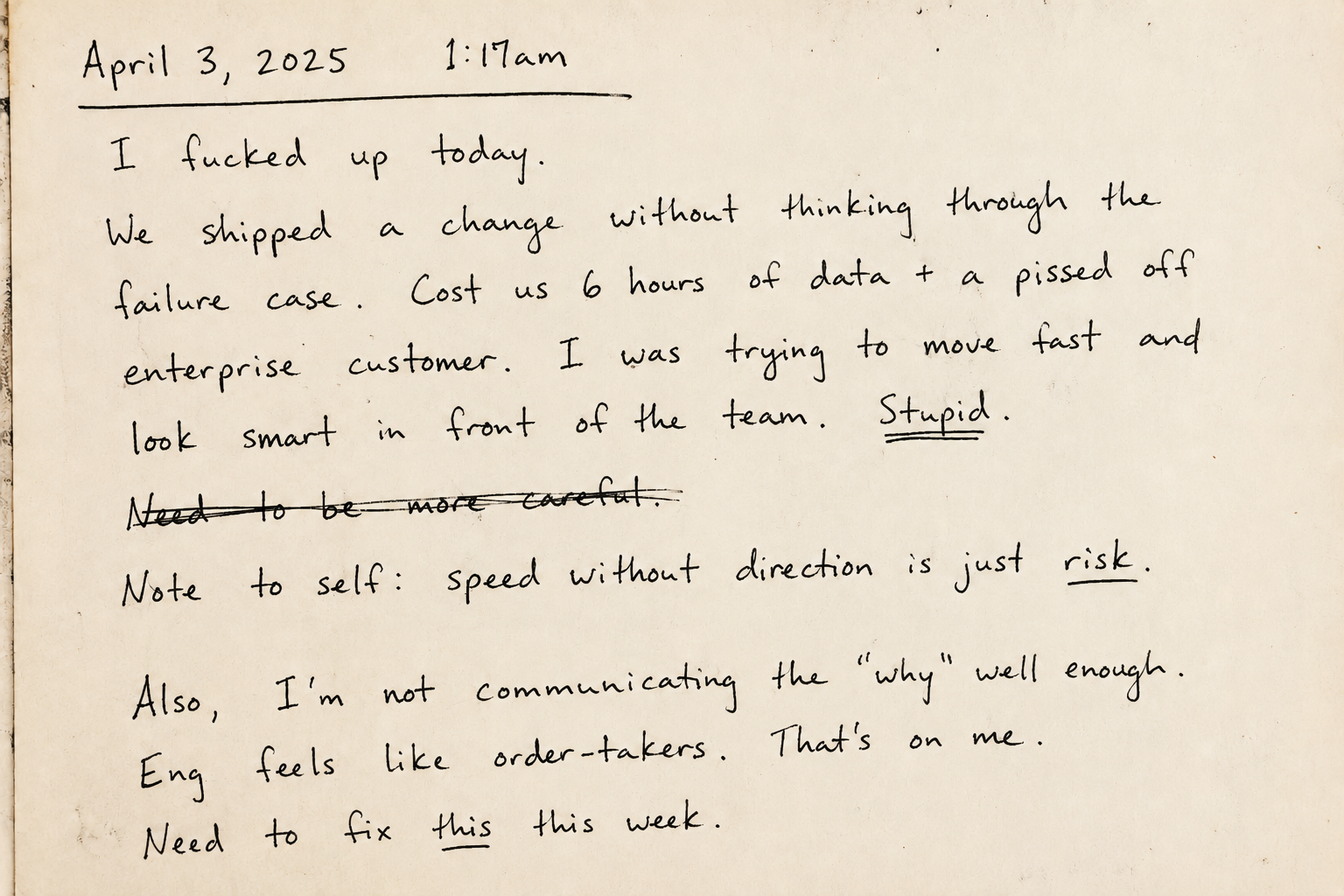

Nobody tells you this when you start building something.
Most founder mistakes don’t feel like mistakes. They feel responsible. That’s why they’re hard to catch.
Nobody wakes up and says, “Today I’ll slowly sabotage my company.”
What usually happens is much less dramatic. You make a series of decisions that feel logical in the moment. They even look smart from the outside. Then six months later you’re exhausted, the business isn’t where it should be, and you can’t point to one big thing that went wrong.
It’s death by reasonable decisions. I’ve noticed this pattern in almost every founder circle.
The trap is rarely lack of effort…It’s misplaced effort.
Take building.
Every founder has had that phase where shipping another feature feels like the answer. There’s something deeply comforting about product work because it gives immediate psychological reward. You make something today that didn’t exist yesterday.
Selling doesn’t give you that.
Selling gives 1) silence 2) Rejection 3) Follow-ups that don’t get answered.
So naturally, many founders become “builders.”
Not because building is what the business needs, but because it protects them from market truth. I’ve seen people spend months perfecting products nobody had actually asked for.
And honestly, this trap is easy to justify. You can always tell yourself you’re improving quality.
Sometimes you are.
A lot of times, you’re just hiding. Then there’s the busyness trap. This one is brutal because modern business culture rewards looking overwhelmed.
A packed calendar has somehow become proof of importance.
- Back-to-back meetings.
- Slack messages at midnight.
- Notion dashboards for everything.
It creates the illusion that serious things are happening.
But if revenue, retention, or customer pull isn’t improving, then all that activity is just corporate cosplay.
Some founders accidentally build operating systems for businesses that don’t yet need operating systems. It’s like installing traffic lights in a village. Looks sophisticated. Solves nothing.
Another trap nobody talks about enough is early praise. This one is almost unfair.
When you’re building, people will encourage you.
- “This is huge”
- “You’re onto something”
- “Love what you’re building”
Feels GREAT…Means almost nothing.
People are generous with encouragement because encouragement is free.
Payment is where honesty begins.
I know founders who mistook applause for validation and spent a year scaling enthusiasm instead of demand.
The market has a very simple language.
It pays, or it doesn’t.
Everything else is noise.
Then there’s founder ego, which is trickier because it often wears the costume of conviction. This is the one that hurts the most because every founder needs a certain amount of irrational belief.
If you were purely rational, you probably wouldn’t start. The problem is knowing when conviction has quietly become attachment. There’s a fine line between persistence and refusal to listen.
Some founders keep pushing because they believe. Others keep pushing because changing direction would bruise their identity. Those are not the same thing.
And maybe the most subtle trap of all is early success.
People think struggle is what kills startups.
Sometimes comfort does more damage.
- A few wins come in
- Revenue starts flowing
- Things feel stable enough
- And the hunger softens
- You stop questioning assumptions
- Stop experimenting as aggressively
- Stop moving like survival depends on it.
That’s dangerous.
Because early traction is often just proof that something can work. It’s not proof that it will keep working.
Founders don’t usually fail because they’re lazy.
They fail because they mistake temporary signals for permanent truth.
If there’s one thing building teaches you, it’s this:
The biggest threat to a founder is rarely competition.
It’s self-deception.
The ability to tell yourself a flattering story about why things are fine, why this delay is strategic, why this feature matters, why this customer feedback is an exception.
The founders who survive longer aren’t always smarter.
They’re just more brutally honest with themselves.
And that’s a hard skill.
Because honesty often feels, in the moment, like defeat. Until later, when you realize it was the only thing keeping you in the game.
Disclaimer: No founders were harmed while writing this.
Mostly because the ones who needed to read it were busy adding another feature.
10 honest founder traps (based on experience and observation):
- Building more when you should be selling
- Confusing busy days with productive days
- Falling in love with your first idea
- Taking compliments as customer validation
- Hiring before the business earns it
- Looking like a company instead of becoming one
- Solving interesting problems, not urgent ones
- Calling ego “long-term vision”
- Becoming the bottleneck in your own business
- Getting comfortable after early wins
