

Over the last few months, I’ve had a feeling I couldn’t quite put words to.
The current AI wave feels familiar and I think I finally understand why.
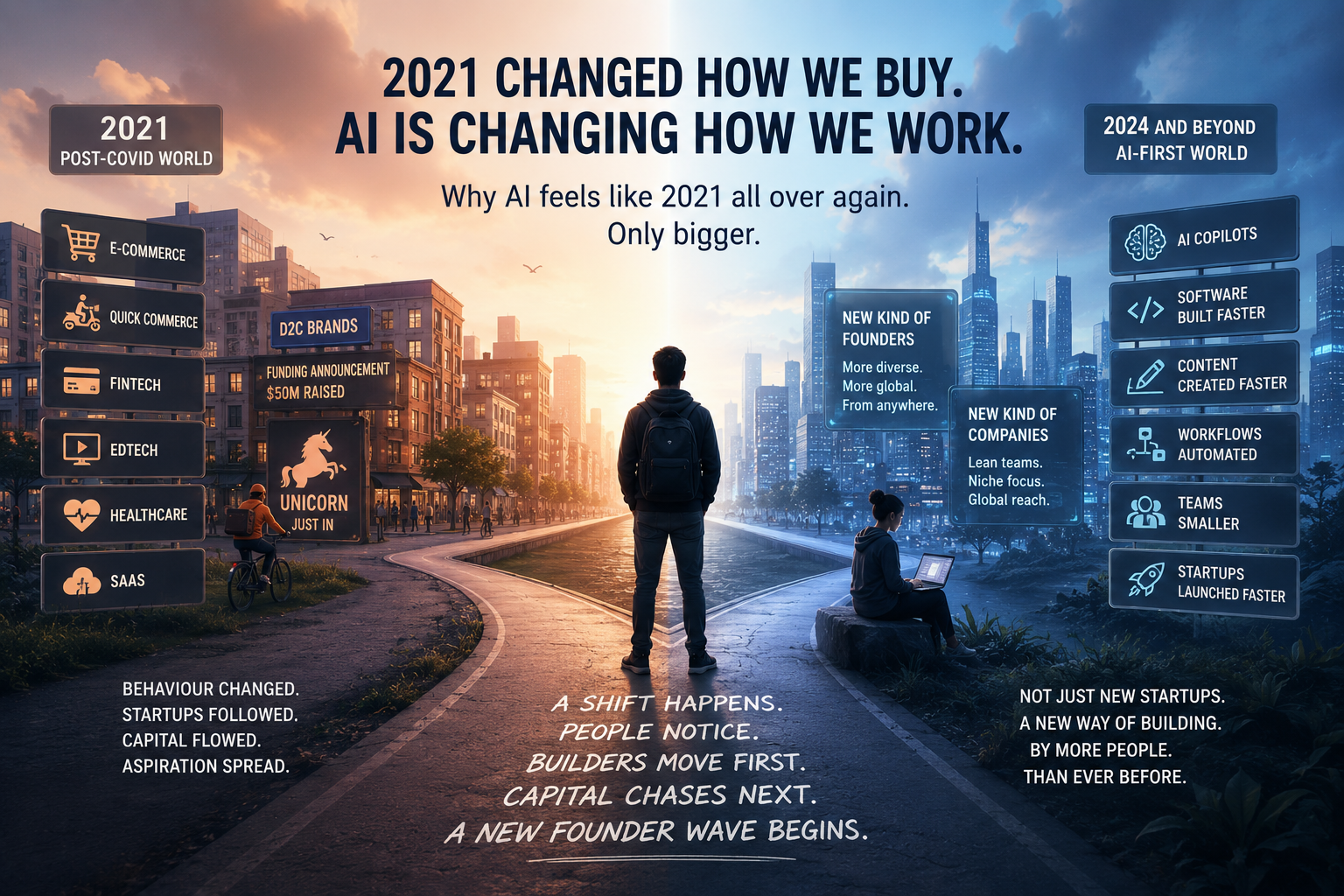
It feels a lot like 2021.
Back then, the world had just come out of Covid. Life had changed almost overnight.
- People were ordering everything online
- Work moved remote
- Payments became digital
- Convenience stopped being a luxury and became an expectation.
Suddenly startups solving everyday problems became incredibly valuable.
- Delivery apps grew faster
- D2C brands raised money
- Fintech took off
- SaaS expanded everywhere.
Money followed behaviour.
Then something else happened.
- People started seeing these companies in the news every day
- Fundraises
- Unicorn announcements
- Founder stories.
And that did something bigger than just move capital.
It changed ambition.
A lot of people started thinking:
“Maybe I can build something too.”
That part is easy to miss when we talk about startup booms.
- It’s not just money creating companies
- It’s visibility creating aspiration.
Now I’m seeing something very similar happen again with AI.
But this time the shift feels deeper.
Covid changed how we bought, AI is changing how we work.
That’s a much bigger surface area.
This isn’t limited to one customer category or one industry.
- Writers are using it
- Designers are using it
- Developers are using it
- Sales teams are using it
- Students are using it
- Founders are using it.
And more importantly, people aren’t just using AI tools.
They’re building around them.
Everywhere I look, people are experimenting.
- Someone building a one-person product on weekends
- Someone leaving a job to build an AI workflow company
- Someone launching a niche tool for a specific industry
- Someone who never thought of themselves as “technical” suddenly trying to ship something.
That feels very familiar.
Just like in 2021, a shift happened first.
Then startups followed.
Then capital followed.
Then attention followed.
And now aspiration is following.
That’s usually how these waves begin.
The interesting difference is this:
- 2021 was driven by a change in consumer behaviour
- AI is being driven by a change in human capability.
People feel like they can suddenly do more than they could before.
- Build faster
- Write faster
- Research faster
- Prototype faster
- Work with smaller teams
- Start with fewer resources.
When capability expands, ambition expands with it.
That’s why this feels bigger.
- We may still see hype
- We may still see overfunding
- We may still see companies that won’t survive.
That happens in every cycle.
But underneath the noise, something real is happening.
And when something real changes how people behave or how people work, entrepreneurship usually follows.
That’s why AI reminds me of 2021.
Not because the headlines look similar.
Because the human pattern underneath feels exactly the same.
- A major shift happens
- People notice
- Builders move first
- Capital chases next
- And a new founder wave begins.
But the more I think about it, the real story may not be that AI feels like 2021 again. That part is already visible.
What feels more interesting is what comes next?
Because every startup wave doesn’t just create new companies. It changes who gets to build them.
2021 gave rise to a certain kind of founder and a certain kind of startup. AI may do the same, but the shape could look very different this time.
- Different founders
- Different company sizes
- Different starting points
- Different paths to building something meaningful.
And that may end up being the bigger shift hiding underneath all the noise.
The next founder wave may not look like the last one.
1. The AI boom will create fewer startups, but far more businesses
This one is interesting.
2021 created a lot of venture-backed startups.
AI may create something different: Small profitable businesses built by tiny teams.
Because one person can now do the work of many:
- build product
- write copy
- design landing pages
- run support
- sell.
You may see:
- more founders
- more products
- more revenue-generating businesses
…but not necessarily more traditional startups.
Less “raise VC”. More “build cashflow.”
That’s a meaningful shift.
2. The next big companies may come from industry insiders, not Silicon Valley founders
This one feels very under-discussed.
The winners may not be “AI-first people.”
They may be operators from existing industries who deeply understand a workflow.
For example:
- a poultry operator building tools for farms
- an HVAC expert building software for contractors
- a doctor building for clinics
- a logistics operator building for fleet management
AI becomes infrastructure.
Domain expertise becomes the differentiator.
That changes who gets to build.
3. AI may reduce the cost of starting, but increase the difficulty of standing out
This feels true already.
Building is becoming easier.
Distribution is becoming harder.
If everyone can create:
- websites
- products
- content
- code
Then scarcity shifts elsewhere.
What becomes valuable?
- trust
- customer access
- reputation
- brand
- proprietary workflow
- community
That’s a very interesting future prediction.
4. The next startup boom may happen outside traditional startup ecosystems
This is probably the boldest one.
Because AI lowers execution barriers, more founders may emerge from:
- Tier 2 and Tier 3 cities
- existing family businesses
- SMEs
- industry professionals
- operators inside traditional sectors
Not everyone needs to move to Bengaluru or San Francisco anymore.
That changes the map of entrepreneurship.
Maybe that’s why this moment feels familiar. Not because history is repeating itself exactly.
But because the pattern is.
- A shift happens
- People notice
- A few start building
- Then many more follow.
We saw that after Covid.
We’re seeing it again now with AI.
The difference is that this time, the tools are reaching far beyond startups and tech circles. They’re reaching operators, specialists, small business owners, people inside industries who may never have called themselves founders before.
That’s what makes this moment worth paying attention to.
The biggest outcome of the AI wave may not just be new products or heavily funded companies.
It may be an entirely new generation of builders emerging from places we weren’t looking before.
Disclaimer: These are personal observations based on patterns I’m noticing across startups, technology, and founder behaviour. Like every wave, some of this may play out differently than expected. The intention here isn’t to predict outcomes with certainty, but to think out loud about where things may be heading.
