
We celebrate the poultry entrepreneur.
We celebrate the person who built the farm, expanded the integration, commissioned the feed mill, increased placements, entered new markets and built a profitable business.
And rightly so.
But somewhere behind those numbers is a professional who is often taken for granted.
The poultry veterinarian!
Not because the veterinarian is less important.
Perhaps because the veterinarian’s contribution is so deeply embedded in the business that we stop noticing it.
The veterinarian is there when the flock is doing well.
But more importantly, the veterinarian is there when something is going wrong.
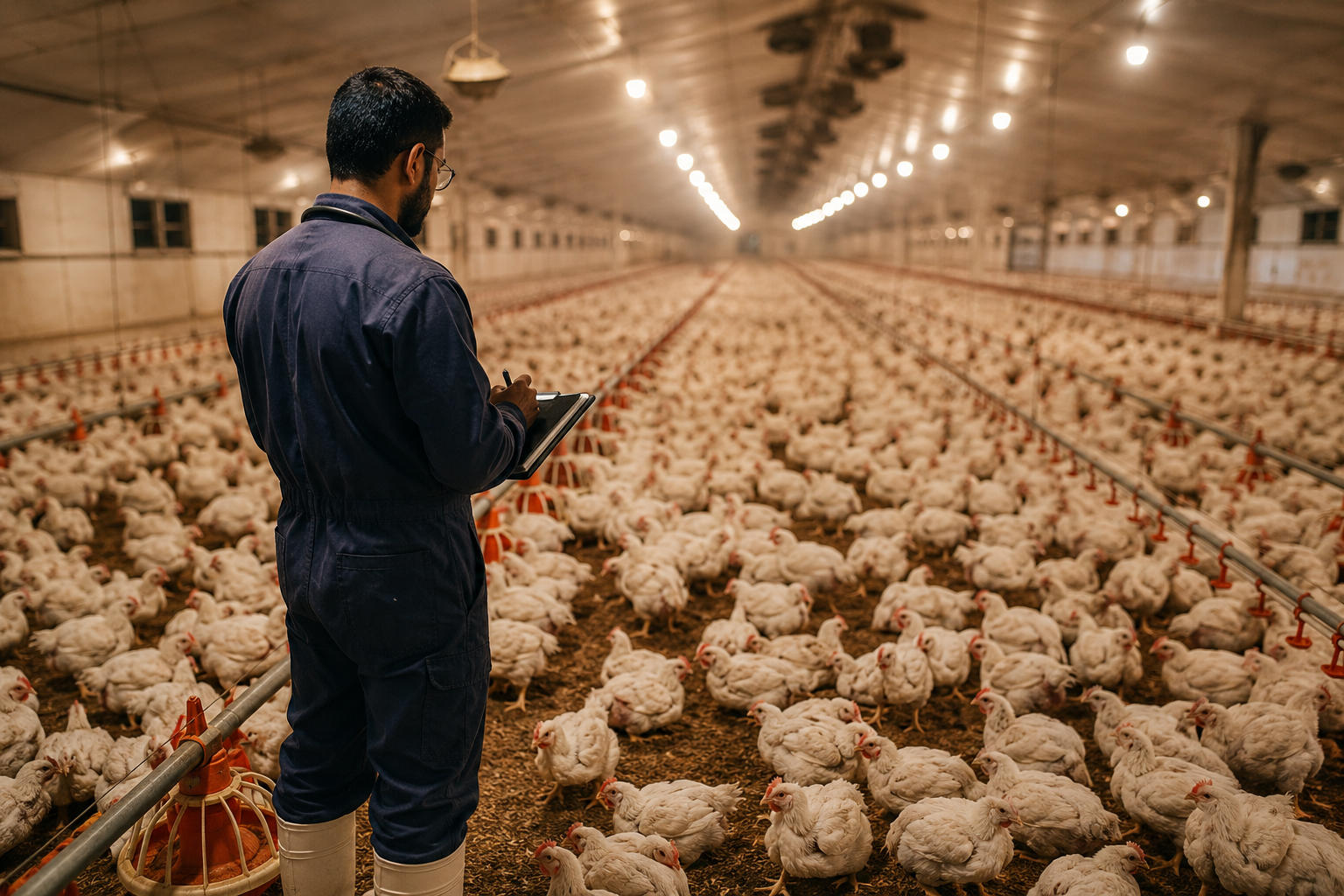
The veterinarian lives with the birds
And poultry rarely gives anyone the luxury of waiting until Monday morning.
There is something fundamentally different about being a poultry veterinarian.
You can study animal health in a classroom.
You can understand epidemiology from a textbook.
You can learn pharmacology, pathology and microbiology.
But eventually, you have to stand inside a poultry house.
–> You have to look at the birds
–> You have to observe their behaviour
–> You have to notice something that doesn’t look right
–> You have to make a decision with incomplete information
And then you have to live with the consequences of that decision.
That is where veterinary knowledge becomes something else.
It becomes judgement
The Veterinarian Is More Than a Farm Visit
When we say “poultry veterinarian,” we sometimes imagine the person walking through a poultry house.
But the profession is much broader.
There are veterinarians working in pathology, diagnostics, nutrition, vaccinology, epidemiology, hatchery health, food safety, research and technical leadership.
Some spend their days with birds. Others spend them with microscopes, laboratory samples, data, feed formulations or research papers.
Their workplaces may be completely different, but their objective is connected: to understand biology well enough to protect flock health and make better decisions.
And those decisions eventually reach the same place —> the health of the bird, the livelihood of the farmer and the profitability of the business.
Emotional, but practical
Perhaps this is one of the most interesting contradictions about a poultry veterinarian.
–> They are emotional.
–> They care about animals.
–> They see sickness and mortality differently from someone looking at a spreadsheet.
But they are also remarkably practical.
Because poultry is a business.
A veterinarian cannot simply say, “Let’s try everything possible.”
Someone has to consider the cost.
- The timing
- The economics of the flock
- The likely outcome
- The implications for the farmer
- The consequences of treatment
The veterinarian has to care deeply about the bird while understanding that the flock is also someone’s livelihood.
That combination of empathy and commercial realism is not easy.
Vulnerable like everyone else. Responsible like few others.
The poultry veterinarian has a family too.
- There are personal commitments
- There are difficult days
- There are moments when they would rather be somewhere else
Yet a sick flock does not understand personal schedules.
- A disease outbreak doesn’t wait for a family function
- A hatchery problem doesn’t care whether it is a Sunday
- And somewhere, there is a farmer waiting for an answer
So the veterinarian goes.
Not because they are somehow less human than the rest of us.
Precisely because they are human —> and still choose to take responsibility.
That deserves recognition.
Strategy is sometimes learned with boots on the ground
We often use words like strategy, execution, risk management and decision-making in business schools and corporate boardrooms.
The poultry veterinarian experiences all of them differently.
- Risk management is biosecurity
- Strategy is deciding what matters most in a flock
- Execution is getting the vaccination programme right across thousands of birds
- Data interpretation is looking at mortality, weight gain, feed intake and flock behaviour and figuring out what the numbers are trying to say
- Decision-making is making the call when there isn’t perfect information
And execution happens with boots on the ground.
–> No PowerPoint presentation can replace that
There is a kind of education that no classroom can fully provide. It comes from being close to the operation —> standing in the farm, making decisions with incomplete information, and living with the consequences.
It doesn’t come with a certificate, It comes from years of field experience.
The backbone of poultry profitability
We often think profitability is created by buying feed at the right price, selling birds at the right price, improving FCR or increasing scale.
All of these matter.
But none of them matter much if the flock isn’t healthy.
- A small improvement in productivity across millions of birds can be worth a great deal
- And a disease problem can erase months of operational excellence in a matter of days
That is why the veterinarian is not merely a technical support function.
The veterinarian is part of the economics of poultry.
- Healthy birds convert feed better
- Healthy birds grow better
- Healthy birds survive better
- Healthy birds reduce avoidable costs
- Healthy birds create predictable production
And predictable production is the foundation of a predictable business.
The veterinarian may not appear directly on the profit-and-loss statement.
But their decisions are often written all over it.
Beyond Profitability
The veterinarian’s work ultimately reaches beyond the balance sheet. Healthy flocks mean more predictable production of affordable animal protein, quietly contributing to food security. Perhaps that is why the job demands so much of them because biology doesn’t follow office hours, and when the flock needs them, they show up.
They have families, responsibilities and difficult days like everyone else. Yet somewhere, there are birds depending on their judgement. And they go.
Perhaps we take them for granted
This is where the industry needs some introspection.
We celebrate entrepreneurs because their achievements are visible.
- We celebrate new investments
- New plants
- New farms
- New brands
- New milestones
But the veterinarian’s biggest achievements can be invisible.
- A disease that didn’t spread
- A flock that didn’t collapse
- A mortality spike that was controlled early
- A treatment decision that prevented a bigger loss
- A farmer who received the right advice at the right time
These don’t make for spectacular headlines.
But they are the everyday victories that keep the poultry business moving.
Not every hero needs a headline
I don’t want to romanticise the profession.
- Poultry veterinarians make mistakes
- They get tired
- They get frustrated
- They disagree with farmers and business owners
- They have commercial pressures
- They have families waiting at home
- They are not superheroes
And perhaps that is exactly the point.
They are ordinary people carrying an extraordinary level of responsibility.
They stand between biology and business.
Between disease and productivity.
Between uncertainty and a decision.
And they do it, very often, without much recognition.
So perhaps the next time we celebrate a poultry entrepreneur for building a profitable business, we should also look around and recognise the veterinarian who helped make that profitability possible.
Because strategy is not always created in an air-conditioned boardroom.
Sometimes it is created in a poultry house, wearing gumboots, looking at a flock and deciding what needs to be done next.
The poultry industry has many people who build the business.
But the veterinarian is one of the people who keeps the biology behind that business working.
And perhaps we have been taking that contribution for granted for far too long.
Disclaimer: I am not a veterinarian, so no veterinary prescription, vaccination schedule, or treatment protocol was harmed in the writing of this article. This is simply the perspective of someone who has spent enough time around poultry to realise that the person looking at the birds often knows more about the business than the spreadsheet does.
