
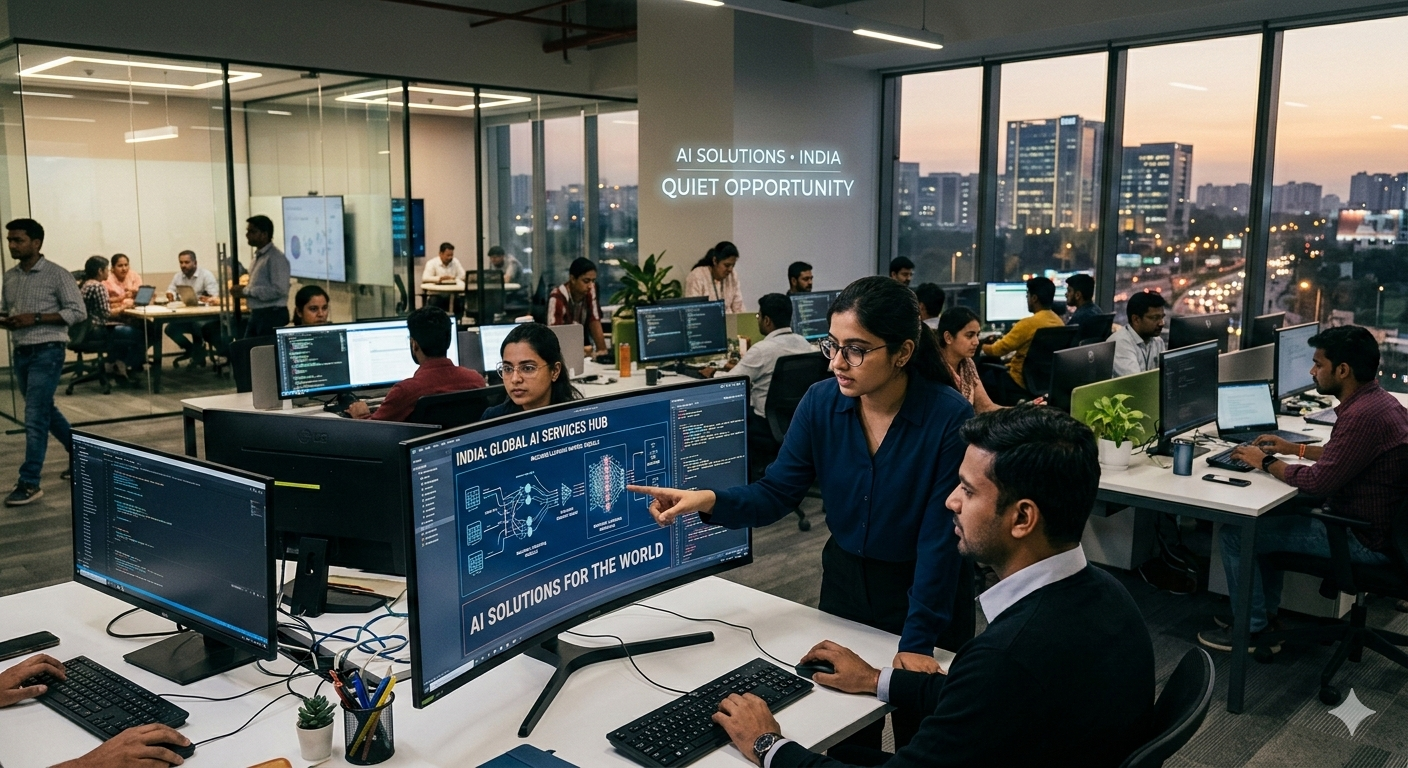

(Reflections after attending the AI Impact Summit India, 2026)
I recently attended the AI Impact Summit India 2026 in my home town New Delhi. Like most AI gatherings today, the conversations kept returning to familiar topics compute, GPUs, large models, and infrastructure. Everyone seemed focused on who controls the engines of artificial intelligence. Companies like OpenAI, Google, and Microsoft were often mentioned as the leaders pushing the frontier. Hardware companies such as NVIDIA have become central to the conversation.
The tone felt different from a year ago. Panels were less about flashy demos and more about strategy.. the global race for AI had arrived. But as I listened, one thought kept returning..the biggest opportunity for India may not lie in building models or infrastructure. It may lie in helping the world actually use AI.
What Is Missing in the Conversation
AI is powerful, but it rarely works out of the box. Organizations struggle with:
- Messy data
- Legacy systems
- Multiple languages
- Informal workflows
- Human resistance to change
Someone has to bridge the gap between AI technology and the real world. That gap is where an AI services economy begins.
What AI Services Look Like
If AI adoption grows, an entire industry of services will naturally emerge. These services focus on making AI usable, not on building the models themselves.
1. AI Integration – Organisations will need help integrating AI into existing software systems and operational processes. This includes connecting AI models with databases, automating workflows, and redesigning how decisions are made inside companies.
2. Data Preparation – AI systems depend heavily on structured and reliable data. In reality, most organizations have data that is incomplete, inconsistent, or scattered across different systems. Preparing data for AI will itself become a large services industry.
3. Workflow Design – Designing workflows where humans and AI collaborate effectively will require deep understanding of both technology and operations.
4. Workforce Training – Millions of employees will need to learn how to work alongside AI systems. Training programs, adoption strategies, and workforce transition services will become essential.
5. Operations & Maintenance – Once deployed, AI systems need constant monitoring and improvement. Models drift, data changes, and systems must be updated regularly. Managing this lifecycle will create long-term service opportunities.
India’s Historic Advantage
This pattern is familiar. During the rise of the internet economy, India built a global reputation in technology services. Companies like Tata Consultancy Services, Infosys, and Wipro did not invent the internet.
Instead, they became experts in making technology work at scale. Banks, airlines, governments, and retailers around the world relied on them to adopt new systems.
AI may require the same translation layer. Not every country can integrate AI into messy, real-world operations. India can.
When we were small, one uncle in the neighbourhood used to say, “Computer aa raha hai, jobs jaengi.” The belief was simple. Once computers come, machines will do everything and people will lose jobs.
But something very different happened. Instead of losing jobs, India created an entire industry around computers. Computer science engineering became one of the most popular courses. Millions of young Indians entered the technology workforce.
Companies like Tata Consultancy Services, Infosys and Wipro did not invent the internet or the core technologies behind it. But they became very good at something else. They became experts at making technology work for organisations.
Banks, airlines, governments and retailers around the world depended on them to adopt new systems and run them at scale. In many ways, India became the country that helped the world use technology, not just invent it.
Artificial intelligence might follow a similar path.
AI systems are powerful, but they don’t automatically work inside real organizations. Data is messy, systems are old, and workflows are complicated. Someone has to make all of this work together.
And if history is any guide, that may be where India’s real advantage lies.
The Global Opportunity
If India focuses only on building models or infrastructure, it may miss the bigger prize. The AI services economy could allow India to become the country that helps the world deploy and operationalise AI. The global race today is just about technology. In reality, It’s about adoption, integration, and execution. History shows that the winners are often the countries and companies that help others make new technology work, not just the ones that invent it.
At the AI Impact Summit India, everyone kept talking about compute and models. But the real opportunity might be elsewhere: helping organisations actually use AI. India doesn’t have to build every model. It can build the systems and services that make AI work in the real world. History tells us this is exactly what India does best.
The Strategic Question for India
If AI becomes deeply embedded across industries, the global economy will need partners who can help organizations deploy and operate these systems at scale. India could choose to compete primarily in building models and infrastructure. But there is another path…. India could become the country that helps the world make artificial intelligence work.
Institutions shaping India’s technology strategy including NITI Aayog and initiatives such as the IndiaAI Mission – may find that the largest opportunity lies not only in developing AI technologies, but in building a globally competitive AI services economy.
If that happens, the next chapter of India’s technology story may look surprisingly familiar……Not just building artificial intelligence.
But helping the world use it.
