

Enterprise AI 2030
Artificial Intelligence is reshaping every enterprise software category. Over the coming months, I’m studying ten companies that represent different parts of this transformation –> from enterprise trust and knowledge management to workflow automation, vertical AI, and process intelligence.
Each essay asks a simple question: What must this company become by 2030 to build a durable business?
The goal isn’t to review products or predict quarterly results. It’s to understand how enterprise AI is changing the design and operation of organizations.
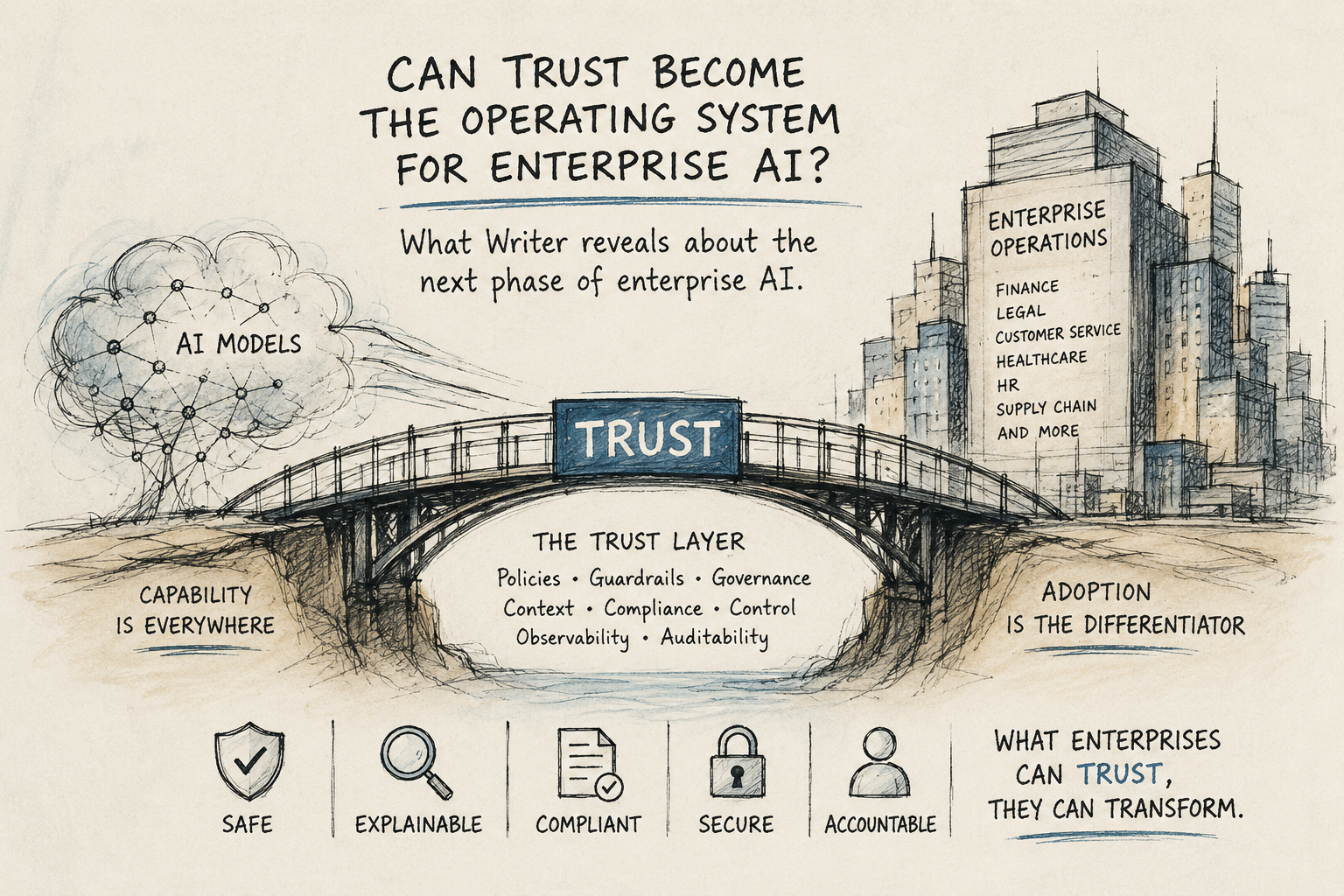
What Writer reveals about the next phase of enterprise AI.
When ChatGPT arrived, most enterprise conversations revolved around one question
“What can AI do?”
Two years later, I think the question has changed. Today, the more interesting question is:
“What can an enterprise trust AI to do?”
Those sound similar, but are not
The first is a technology question, The second is an operating model question.
A few years ago, the conversation around enterprise AI was surprisingly simple.
- Can a language model write a marketing email?
- Can it summarise a document?
- Can it answer questions from a knowledge base?
For a while, those were the right questions. The technology was new, and everyone wanted to know what it could do.
Today, those questions feel much less interesting.
Most enterprises no longer doubt whether AI is capable. That debate is largely over. The models continue to improve, but the differences between them matter far less than they did a couple of years ago.
The question I find myself asking now is different ->
What does it take for a large enterprise to trust AI enough to make it part of everyday work?
Writing an email is one thing.
Helping a bank communicate with customers, assisting lawyers with contracts, supporting healthcare professionals, or becoming part of a regulated business process is something else entirely.
In those situations, being “mostly right” isn’t enough.
An enterprise needs to know where an answer came from –> Whether it followed company policy –> Whether confidential information remained protected –> Whether the decision can be explained months later if someone asks.
When I started reading about Writer, I assumed I was studying an AI writing company.
By the time I finished, I wasn’t so sure –> Somewhere during my research, I realized I had been asking the wrong question.
I wasn’t studying an AI writing company.
I was studying how an enterprise decides whether AI is ready to become part of its everyday operations.
I found myself thinking about trust.
The product looked like a collection of unrelated capabilities until I stopped looking at individual features and started asking what problem they were collectively trying to solve.
Individually, they look like product features.
After a while, a pattern starts to emerge.
Writer doesn’t seem to be solving the problem of generating content.
–> It seems to be solving the problem that begins after an enterprise decides it wants to use AI.
Getting access to a powerful model is no longer the hard part.
Making that model useful inside a large organisation is
- Someone has to connect it to company knowledge
- Someone has to define what the AI is allowed to do
- Someone has to satisfy legal, compliance and security teams
- Someone has to integrate it into existing business processes
- Someone has to ensure that employees actually trust it enough to use it
That is where most enterprise AI projects become difficult.
Technology is rarely the project that fails –> Adoption is
And that’s where I think Writer is placing its bet.
The more I thought about it, the more it reminded me of something we’ve seen before.
When electricity first arrived, factories proudly advertised that they had electricity. Today, nobody chooses a factory because it has electricity. Nobody builds strategy around having electricity anymore.
They build strategy around what electricity allows them to do.
I think AI is moving in the same direction.
–> They will continue to improve
–> They will become more capable
But over time, access to intelligence becomes less of a differentiator. When everyone can buy intelligence, competitive advantage has to move somewhere else.
I think the next competitive advantage won’t come from having more intelligence.
It’ll come from removing more execution friction than competitors.
An enterprise may know exactly what it wants AI to do. It may have executive sponsorship, budget and capable technology teams. Yet projects still stall because security raises concerns, legal requests additional controls, business units disagree on ownership, or nobody is willing to let AI influence a real customer-facing process.
The gap isn’t technological anymore.
–> It is organisational trust
Enterprises don’t have an AI problem –> They have a trust problem
That’s why I think Writer’s future won’t be defined only by the quality of its models.
Model quality will always matter, but the harder problem is building enough confidence that an enterprise allows AI to become part of its operating model.
If that observation is correct, then Writer’s future looks different from its past.
I may be wrong, but if I’ve understood Writer correctly, its bigger ambition is to become the layer that enterprises trust to put AI into production.
Its long-term value will come from helping enterprises answer questions such as:
- Can we trust this response?
- Can we explain this decision?
- Can we prove compliance?
- Can we improve this workflow over time?
- …..
Those are not just model questions
–> They’re questions about running an enterprise.
This also changes who Writer is really selling to
–> The early buyers of enterprise AI were often innovation teams experimenting with new technology.
I suspect the next buyers will look very different.
They’ll be the people responsible for
- Risk
- Operations
- Compliance
- Transformation
That’s why I think the buyer gradually shifts from the Head of Innovation to the people accountable for how the business actually runs.
That is a much bigger conversation and also a more durable one, It also explains why I don’t think Writer’s biggest challenge is building a better model.
Its biggest challenge is becoming valuable enough that enterprises continue to choose Writer even as foundation models become more capable and enterprise-ready.
That is a much harder problem.
That means Writer cannot rely on having the best model forever.
But if Writer succeeds, it will have built something much more durable than another AI application.
What This Means for India
I think India represents two different opportunities for Writer.
–> The obvious one is selling enterprise AI to one of the world’s fastest-growing digital economies.
The less obvious one may be even more important.
Many of Writer’s existing global customers already run significant parts of their business through Global Capability Centers in India.
That means India isn’t only another market.
–> It can become an extension of relationships Writer already has.
If I were thinking about building Writer in India, I wouldn’t start by asking how many new customers we could acquire.
I’d start by asking which existing global customers already have thousands of people working from India and how Writer could expand those relationships first.
Alongside that, I’d focus on industries where trust matters most –> banking, insurance and healthcare.
Those are the places where governance, audit-ability and control aren’t optional features. They’re core requirements.
I also wouldn’t rush to build a large direct sales organisation.
India has one of the world’s strongest enterprise technology ecosystems. System integrators, consulting firms and cloud providers influence a large percentage of enterprise technology decisions.
I’d build with that ecosystem rather than around it.
If Writer’s long-term opportunity is to become the trusted operating layer for enterprise AI, India shouldn’t simply become another sales territory –> It should become one of the places where that operating model is proven at scale.
Every global software company eventually has to answer the same question:
“Is India just another market, or can it become part of our competitive advantage?”
I think Writer has the opportunity to choose the second path.
The companies that define enterprise AI in the next decade won’t necessarily build the smartest models. They’ll build the organizations that enterprises trust enough to put those models to work.
This is the first essay in my Enterprise AI 2030 series, where I’m studying ten enterprise AI companies through the lens of strategy, execution, and long-term competitive advantage.
