


What is the price of peace?
In the Mahabharata, the ultimate answer was surprisingly small: just five villages.
After returning from a grueling thirteen year exile, the Pandavas were legally entitled to their half of the Kuru kingdom. Yet, knowing the catastrophic human cost of an all-out world war, Yudhisthira made a shocking compromise. He sent Lord Krishna to the courts of Hastinapur with a microscopic demand: Give the five brothers just five simple villages to rule, and they would drop all claims to the empire.
Duryodhana famously sneered, refusing to part with “even as much land as can be pierced by the point of a needle.” The rest is bloody history.
But what if Duryodhana had swallowed his pride, listened to his elders, and said yes?
If those five villages had been handed over, the Kurukshetra war would have vanished from the timeline. Here is the alternate history of what would have happened next, and the profound business and life lessons hidden inside this cosmic “What If.”
The Alternate Timeline: A Subcontinent of Two Kingdoms
Had Duryodhana accepted the peace offering, the immediate threat of war would have evaporated. The Pandavas would have taken control of five strategic pockets across the northern plains:
Indraprastha (Delhi), Vyaghraprastha (Baghpat), Swarnaprastha (Sonipat), Panduprastha (Panipat), and Tilprastha (Tilpat).
Initially, a tense, uneasy truce would settle over the subcontinent. It would look remarkably like a modern Cold War.
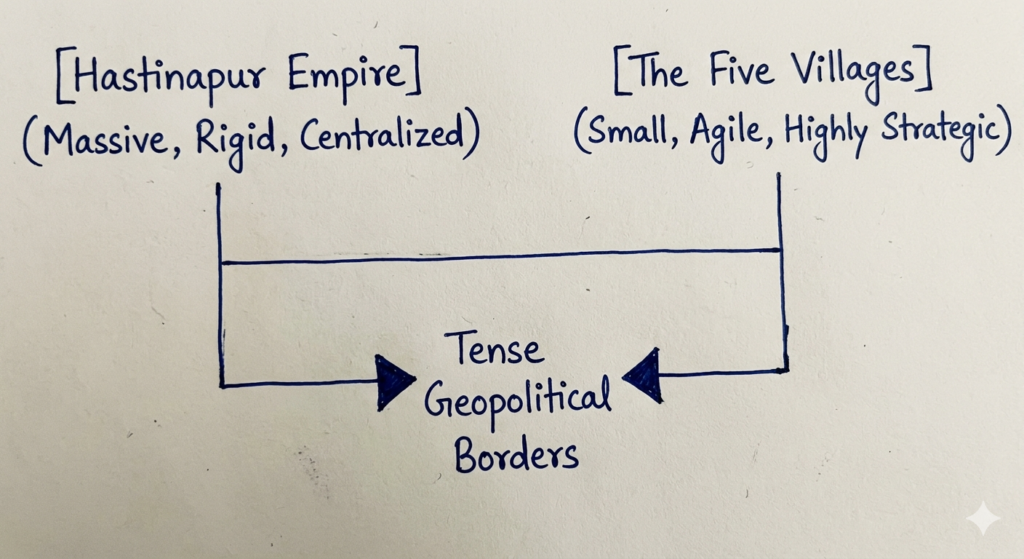
Hastinapur would remain the massive, undisputed superpower on paper, retaining over 95% of the land, the main standing army, and the imperial treasury. The Pandavas would move into their modest new territory, building mud-brick outposts where grand palaces should have been.
But peace would not mean stagnation.
The Macro Shift: Turning Mud into Gold
The assumption that the Pandavas would remain minor, insignificant village chieftains ignores their track record. Years prior, when handed a barren, wild wasteland called Khandavaprastha, they collaborated with divine architects to transform it into the magnificent capital of Indraprastha.
Given five villages—which sit directly on the fertile, highly strategic trade routes of the Indo-Gangetic plains—the Pandavas would deploy their greatest asset: exceptional execution.
Backed by the brilliant geopolitical and economic counsel of Lord Krishna, the Pandavas would rapidly turn these five villages into tax-free, highly efficient, and incredibly prosperous trading hubs.
- Arjuna would secure the borders, creating a safe haven for merchants.
- Yudhisthira’s reputation for absolute fairness would attract top-tier artisans, scholars, and traders who were weary of Duryodhana’s tyrannical taxation in Hastinapur.
- Bhima would manage agriculture and supply chains, turning the fertile plains into a breadbasket.
Within a decade, the balance of power would shift drastically without a single arrow being fired. Hastinapur would find itself economically hollowed out, watching its citizens and wealth slowly migrate to the booming, agile economy of the Five Villages.
The Unforgiven Debt: Why War Was Only Delayed
Would this peace last forever?
Unlikely.
A conflict suppressed is not a conflict resolved.
Duryodhana’s jealousy was systemic, not situational. Watching the Pandavas turn five simple villages into thriving economic powerhouses would infuriate him just as much as their old palace did. He would likely resort to covert economic blockades, proxy border skirmishes, or assassination attempts.
Furthermore, the psychological trauma of the past could not be easily erased. Draupadi’s public humiliation in the dice hall and the insults hurled by Karna were deep emotional wounds. Even if Yudhisthira maintained his vow of peace, the next generation—led by a young, fierce Abhimanyu and Draupadi’s sons—would grow up harboring a burning desire for justice.
Ultimately, the peace achieved by the five villages would only act as a countdown timer. A generation later, a new, perhaps even more complex war for total dominance would inevitably ignite.
Modern Business Lessons from the Five Villages
This alternate scenario serves as an incredible masterclass for corporate strategy, startups, and leadership.
1. Beware the “Founder’s Ego” (The Duryodhana Trap)
Duryodhana is the ultimate cautionary tale of an ego-driven executive. He refused to give up a tiny fraction of equity (five villages) because he viewed compromise as a personal defeat. In doing so, he destroyed his entire enterprise (Hastinapur) and lost his life.
The Takeaway: Rigidly clinging to 100% ownership of a toxic, embattled project is a fast track to ruin. True leaders know when to share equity, when to pivot, and when to give up a small piece of the pie to secure the long-term survival of the company.
2. Value Execution over Capital Assets
The Pandavas proved that it isn’t the size of your initial market that matters; it’s your ability to execute within it. They didn’t need a massive empire to create value; they just needed a foothold.
The Takeaway: In the startup world, a hyper-focused team targeting a tiny, specific niche (a single “village” or market segment) can build a more profitable, sustainable business than a massive, bloated conglomerate trying to boil the ocean. Master your niche before you expand.
3. Exhaust Alternative Dispute Resolution (ADR) First
Before deploying their massive military might, the Pandavas sent their best negotiator to offer an extreme compromise. They did this to protect their resources and avoid a devastating war of attrition.
The Takeaway: In business, price wars and prolonged legal battles destroy value for both sides. Always exhaust every avenue of reasonable compromise, mediation, and partnership before launching an all-out competitive war.
Practical Life Lessons for Personal Mastery
The dynamics of this compromise offer profound wisdom for navigating our daily lives, relationships, and personal ambitions.
1. Build Intrinsic Value, Not Extrinsic Status
Duryodhana’s entire identity was anchored to external symbols—his crown, his throne, and his territory. Without them, he felt empty, which drove his pathological insecurity. The Pandavas, however, knew that their royalty lay within their character, their skills, and their bonds. They could be kings in a golden palace or kings in a thatched hut.
The Takeaway: Never tie your self-worth entirely to your job title, your bank balance, or your material possessions. If you build intrinsic value—resilience, intellect, and integrity—you can be stripped of everything and still have the power to rebuild from scratch.
2. The Power of Strategic Humility
Yudhisthira was willing to look “weak” by begging for just five villages because he valued human life and long-term peace over immediate vindication. It takes immense emotional maturity to swallow your pride for a larger, noble purpose.
The Takeaway: Not every slight requires a confrontation. Choosing to walk away from a toxic argument or accepting a lesser deal to protect your mental peace, your family, or your long-term focus isn’t cowardice—it is high-level strategic thinking.
3. Short-Term Greed Insolves Your Future
Duryodhana thought he won the ultimate victory by keeping the entire empire for himself. But his refusal to compromise entirely isolated him. When the crisis of war arrived, he had no moral legitimacy, and his allies were fighting out of obligation rather than true loyalty.
The Takeaway: Selfishness might give you a quick win today, but it bankrupts your social and moral capital. The way you treat people during a compromise dictates who will stand by you when your life inevitably hits a battlefield.
Conclusion: The Ultimate Balance Sheet
Yudhisthira’s offer of the five villages was not a sign of weakness; it was a brilliant masterstroke of moral clarity. By asking for so little and being denied, the Pandavas stripped Hastinapur of its legitimacy. When the war did arrive, the entire universe knew exactly who was fighting for greed and who was fighting for righteousness.
In our own lives and careers, we will constantly face our own “needle’s point” moments. The next time you are tempted to burn down a bridge out of pure pride, remember Duryodhana—and consider whether it’s wiser to take the five villages, build your empire quietly, and let your execution do the talking.
Disclaimer: Before anyone sends a legion of chariots to our comment section: this article is a strategic business thought experiment, not a religious commentary. We have immense respect for the epic Mahabharata. We are just trying to help modern entrepreneurs avoid blowing up their startups over a “needle’s point” of equity. May the cosmic balance sheet be in your favor.
