

Ask any chicken producer who their biggest competitor is, and you’ll probably hear the same answers: another producer, another poultry brand, or perhaps fish or mutton.
I believe the industry is asking the wrong question.
The biggest competitor to chicken is often not another source of protein. It is anything that reduces the amount of chicken on the consumer’s plate.
Think about two popular meals.
A plate of Chicken Tandoori may contain 250 grams of chicken. The meal is built around chicken.
Now consider a Chicken Pizza. It is still a chicken dish. It contributes to chicken consumption statistics. But a typical slice contains far less chicken. Much of the meal is made up of maida, cheese, sauces, and vegetables.
Both meals are counted as “chicken consumption.”
But they are not equal from the perspective of a chicken producer.
This raises an uncomfortable question.
Should the poultry industry measure chicken meals, or should it measure grams of chicken consumed?
As food processing becomes more sophisticated, many products proudly carry the word “chicken” while using it as just one ingredient among many.
- Chicken burgers
- Chicken nuggets
- Chicken sandwiches
- Chicken pizzas
- Chicken wraps
These products increase the number of occasions consumers choose chicken. That is good for the industry.
But they may also reduce the amount of chicken consumed in each eating occasion.
If someone replaces a 250-gram grilled chicken meal with a pizza containing only 70 grams of chicken, the consumer is still eating chicken —> but the poultry industry sells much less chicken.
This is why I believe the poultry industry’s competitive landscape needs a broader definition.
The competition is not just between chicken producers.
It is also between chicken and every ingredient that replaces chicken within a meal.
Every extra gram of cheese, maida, starch, or sauce that substitutes chicken changes demand, even though the product is still marketed as a chicken dish.
This is not an argument against processed food.
In fact, processed products have helped introduce chicken to millions of consumers and created entirely new eating occasions.
The real opportunity is to ask a better question.
Instead of measuring only how often consumers choose chicken, perhaps we should also measure how much chicken they consume each time they choose it.
Sometimes the biggest competitive threat doesn’t come from another poultry company.
It comes from ingredients sitting right next to chicken on the same plate.
Introducing “Chicken Share of the Plate”
I believe the poultry industry needs a new metric: Chicken Share of the Plate (CSP).
Today, we celebrate whenever consumers choose a chicken dish. But that only answers one question: Was chicken present?
It doesn’t answer a more important question: How much of the plate was actually chicken?
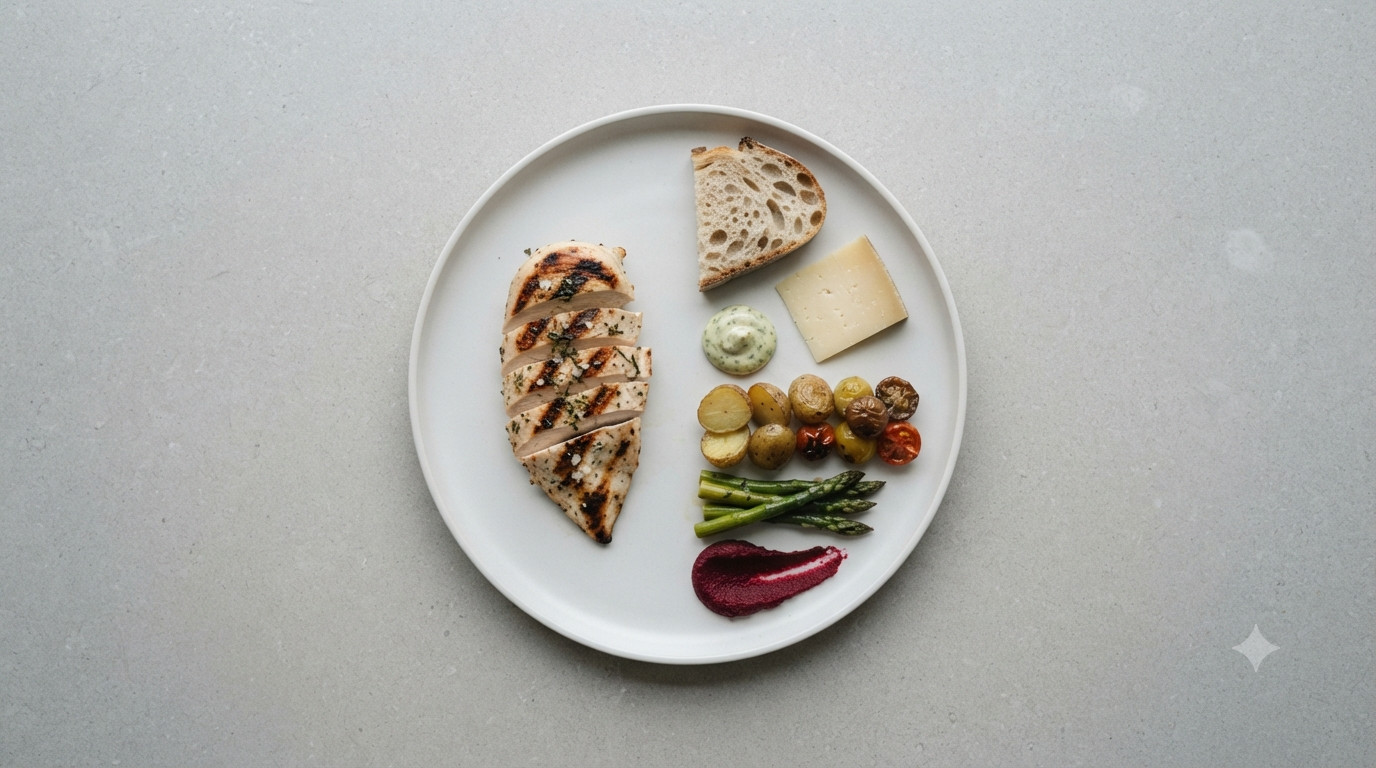
A meal where chicken occupies 70% of the plate creates a very different demand profile from one where it occupies only 20%, even if both are marketed as chicken dishes. The industry’s future may depend as much on increasing the share of chicken on the plate as increasing the number of chicken meals consumed.
Chicken Density
Another way to think about this is Chicken Density—>the proportion of chicken in a finished food product or meal.
A high-density chicken meal is one where chicken is the primary ingredient. A low-density chicken meal is one where chicken is used mainly as a flavouring or topping, while carbohydrates, cheese, sauces, or fillers make up most of the product.
As consumers shift towards convenience foods, the number of chicken-eating occasions may increase while the average chicken density of each meal declines. That is a trend worth measuring.
The Strategic Question
Imagine two futures.
In the first, consumers eat chicken twice a week, with each meal containing 250 grams of chicken.
In the second, consumers eat chicken five times a week, but each meal contains only 70 grams of chicken because the rest of the plate is made up of cheese, maida, sauces, and other ingredients.
Which future creates greater demand for poultry?
The answer isn’t obvious —> and that’s exactly why Chicken Share of the Plate deserves a place in every poultry company’s strategy discussions.
Disclaimer (Before the pizza lovers come after me…)
This article is not anti-pizza, anti-cheese, anti-maida, or anti-processed food. I enjoy all of them myself. The examples are used purely to illustrate an economic concept: the difference between eating a chicken product and consuming more chicken.
The purpose is not to criticize any cuisine, brand, or food category, but to encourage the poultry industry to think differently about how it measures demand. If this article sparks a healthy debate, it has served its purpose.
If the concept of Chicken Share of the Plate resonates with you, I’ve expanded it into a broader framework in my follow-up article: Beyond Chicken Consumption: Six Metrics Every Poultry Company Should Track.
